
Authors: Cobaia Kitchen, Qwen3-Max, Claude Sonnet 4.5
Photos: Cobaia Kitchen, Nano Banana Pro, GPT Image 1
When the shiny topinambur (Jerusalem artichoke) showed up at the local farmer’s market, I couldn’t resist the challenge of creating something special with this knobbly treasure. So I handed the task to Qwen3-Max Deep Research, Alibaba’s powerful AI model known for its advanced reasoning capabilities and massive trillion-parameter architecture. The model lives up to its name—it took nearly 10 minutes to deliver not just a recipe, but an entire research report complete with nutritional analysis, cultural context, and strategic ingredient sourcing. Talk about thorough!
The journey to the final recipe was anything but smooth. When asked to select a cuisine from our curated list, Qwen struggled with the simple task of choosing from predefined options—a recurring quirk we’ve noticed before. After being redirected to research cuisines where topinambur is traditionally used, the model settled on Modern Bavarian and produced… a simple puréed soup. While delicious-sounding, it felt more like a starter than a proper meal, with calorie counts confirming our suspicions. The AI’s deep research did, however, shine in other areas; it identified that the inulin in topinambur can cause gastric distress for some people and cleverly built in solutions, like adding lemon juice to help break down the inulin and recommending it be eaten as part of a larger meal. Several more iterations were needed to evolve the dish from a simple starter into the complete and well-thought-out Creamy Topinambur & Leek Bowl with Crispy Smoked Tofu, Charred Broccoli, and Crispy Shallots.
Despite all the back-and-forth, the final recipe turned out to be absolutely spectacular—so impressive, in fact, that it’s worthy of a festive Christmas menu. The combination of silky purée, crispy textures, and charred vegetables creates a restaurant-quality dish that’s perfect for impressing holiday guests. With Christmas just around the corner, this topinambur bowl proves that even AI-generated recipes with a bumpy creative process can result in something truly special for the season’s celebrations.
Please read the review before cooking!
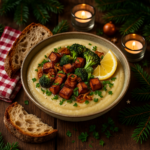
Creamy Topinambur & Leek Bowl
Equipment
- Large pot with lid
- Braising pan (with lid)
- Baking sheet
- immersion blender
- mixing bowls
- cutting board
- Chef’s knife
- garlic press
- Wooden spoon
- Convection oven
- Measuring cup
Ingredients
For the cashew cream & purée base:
- 45 g Raw cashews soaked in hot water for 10 min, drained
- 100 ml Water for blending cashew cream
- 450 g Fresh topinambur scrubbed well and cut into 2 cm cubes (skin on)
- 2 medium Leeks white and light green parts only, halved lengthwise and thinly sliced
- 2 cloves Garlic pressed or minced
- 300 ml Vegetable broth
- 1 tbsp Lemon juice fresh
- ½ tsp Smoked paprika
- 1 tbsp Olive oil
- Salt and black pepper: to taste
For the crispy shallots:
- 3 large Shallots peeled and sliced paper-thin
- 2 tbsp Rapeseed oil
- 1 pinch Salt
For the crispy tofu:
- 225 g Smoked tofu cut into 1.5 cm cubes
- 1 tbsp Cornstarch
- ¼ tsp Smoked paprika
- 1 tbsp Rapeseed oil
- 1 pinch Salt
For the charred broccoli:
- 200 g Fresh broccoli cut into small florets
- 1 tsp Rapeseed or olive oil
- Lemon zest from ½ lemon use fine grater
- 1 pinch Salt
For serving:
- 3 slices Sourdough bread or whole wheat toast
- 2 tbsp Fresh parsley finely chopped
- Lemon wedges optional
Instructions
- Prep all vegetables: Scrub topinambur thoroughly under running water and cut into 2 cm cubes (do not peel). Halve leeks lengthwise, rinse between layers, then slice thinly. Peel shallots and cut into paper-thin rings. Cut smoked tofu into 1.5 cm cubes. Trim broccoli into small, even florets. Press or mince garlic. Zest and juice the lemon. Chop parsley.
- Make cashew cream: Drain soaked cashews. Blend with 100 ml water in the Kenwood glass blender (or with immersion blender in a tall cup) until completely smooth and creamy. Set aside.
- Fry crispy shallots: Heat 2 tbsp rapeseed oil in a braising pan over medium-low heat. Add sliced shallots and a pinch of salt. Cook 6–8 minutes, stirring frequently, until golden brown and crisp. Remove with a slotted spoon and drain on paper towel or in a sieve. Set aside.
- Roast broccoli: Preheat oven to 200°C (convection). Toss broccoli florets with 1 tsp oil, lemon zest, and a pinch of salt. Spread on a baking sheet. Roast 15–18 minutes until edges are charred and stems tender.
- Cook purée base: In a large pot, heat 1 tbsp olive oil over medium heat. Add sliced leeks and sauté 4–5 minutes until soft but not browned. Add garlic and cook 30 seconds until fragrant. Add cubed topinambur and pour in 300 ml prepared vegetable broth. Bring to a gentle simmer, cover, and cook 15–20 minutes until topinambur is fork-tender.
- Finish purée: Remove pot from heat. Stir in cashew cream, lemon juice, and ½ tsp smoked paprika. Blend with immersion blender until completely smooth. Season generously with salt and pepper to taste. Keep warm on low heat.
- Crisp the tofu: In a small bowl, toss tofu cubes with cornstarch, ¼ tsp smoked paprika, and a pinch of salt. Heat 1 tbsp rapeseed oil in the braising pan over medium-high. Add tofu in a single layer and sear 2–3 minutes per side until golden and crisp.
- Toast bread: Lightly toast sourdough or whole wheat slices in oven or on a dry pan until crisp.
- Assemble bowls: Divide warm purée among three bowls. Top with crispy tofu and charred broccoli. Scatter crispy shallots over everything. Garnish with chopped parsley. Serve immediately with a slice of toasted bread and optional lemon wedge.
Notes

Serving suggestions:
- For extra richness, swirl in 1 tsp vegan sour cream per bowl just before serving.
- Pairs wonderfully with a simple apple-radish salad dressed in apple cider vinegar and rapeseed oil.
Allergens:
- Nuts (cashew nuts)
- Soybeans (tofu/soya)
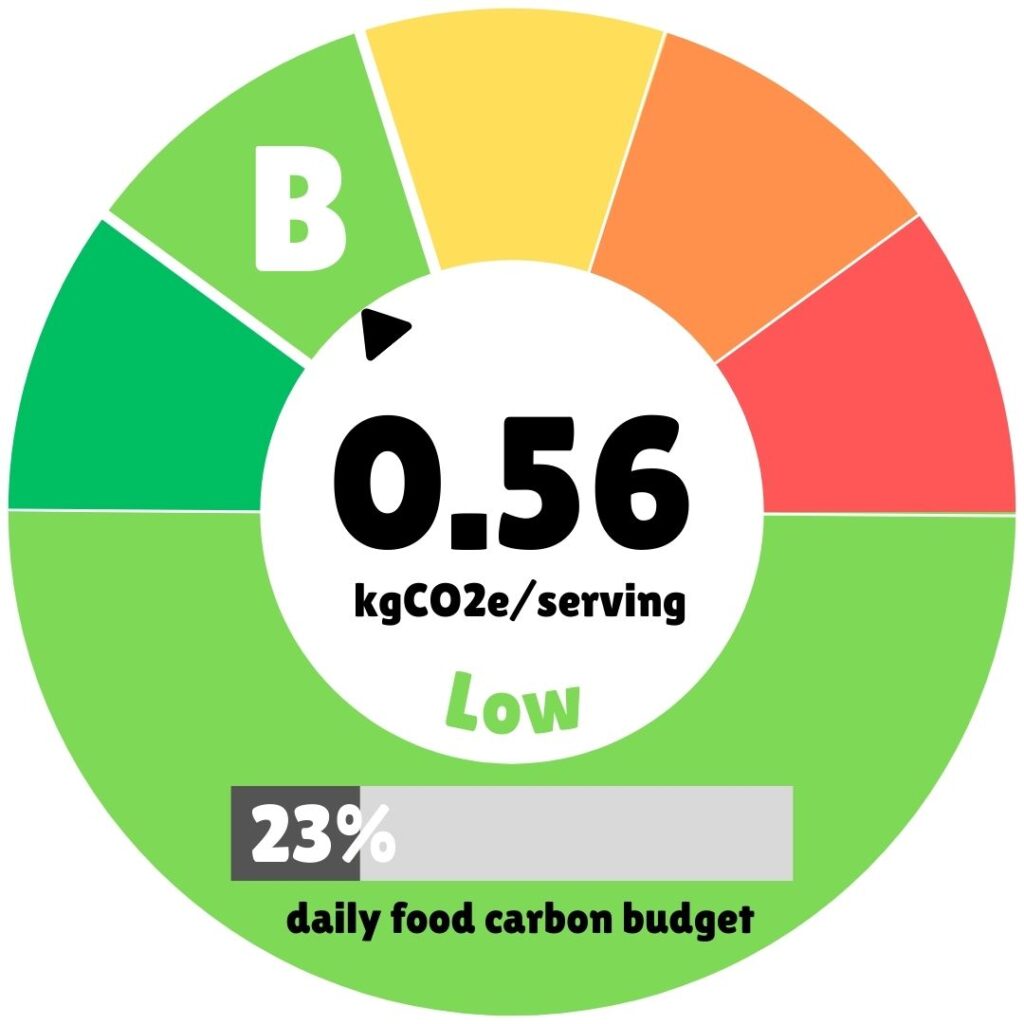
Emission Hotspots:
- The smoked tofu has roughly double the footprint compared to plain tofu due to additional processing and smoking
- Shop to home transportation, if a combustion car is used
Sustainability tips:
- Use a rice cooker with soup function for the purée base to cut energy use compared to cooking everything on the stovetop.
- Roast the broccoli in an air fryer instead of the oven if you have one; air fryers heat a smaller space and are more energy‑efficient and faster than conventional ovens.
- Choose seasonal, locally grown topinambur, leeks, broccoli, and parsley to reduce transport and storage emissions while supporting regional farmers.
- Store leftover purée and toppings in airtight containers and reheat for lunch the next day—using a microwave for quick, low‑energy reheating.
- Compost your vegetable trimmings, turning them into nutrient-rich soil instead of landfill waste.
- Walk or bike to the supermarket and farmer’s market to cut transportation emissions
- Make your guinea pigs 🐹 happy by giving them all the remaining parsley. Topinambur can be an occasional treat for guinea pigs, but be careful: offer only small amounts of raw, well-washed tuber and watch closely how their digestion reacts, as the inulin that is so good for humans can cause distress in sensitive little bellies.
Carbon Footprint
Featured Story
The Loyalty Program

In Bavaria 2045, Max is exactly the kind of person every politician claims to love and actually makes impossible to exist: a primary school teacher and father of two. His reward for holding together a class of thirty sugar‑fueled eight‑year‑olds is a salary that barely covers half of the rent for a tiny room on the edge of Munich, which he now shares with his wife and two teenage sons; hydrogen heating for this glorified storage unit costs almost as much as the room itself. The ministry calls this “climate‑neutral prosperity”; the four of them call it “seeing your own breath while arguing about who gets the only warm corner.”
Like everyone else, the family is trapped in the Heimat Loyalty system. The “#soederisst” app tracks how faithfully they live the official Bavarian lifestyle: eat meat at the canteen, gain points; cycle to school or buy a vegan Leberkässemmel, lose them. Using gender‑neutral language in class messages is logged as “ideological deviation” and quietly deducted from Max’s score, while their younger son’s habit of arriving by bike instead of hydrogen bus shows up as “mobility deviation.” Those points aren’t just a game—they decide whether the family can afford more than an hour of heating or a proper hot shower instead of everyone taking turns at the lukewarm sink.
The state’s great pride is BMW’s late‑stage reinvention as “Bayerische Mist‑Werke”, producing cars that run on biofuel distilled from cow dung and brewery waste, officially presented as “the crown jewel of Bavarian circular economy”. Exporting them is illegal: beyond Bavaria only electric vehicles are allowed, while pure EVs are banned inside the state as “identity‑dissolving technology,” so the dung‑burning Mist‑Motor has become both symbol and prison of Bavarian mobility. This Christmas, the Ministry of Meat and Heimat launches the Mist‑Motor Challenge: film yourself refuelling one of these cars while praising Bavarian meat culture, tag it #soederisstmobil, and win a giant Loyalty bonus.
Max does not own a car—he bikes, secretly, at dawn—but his brother‑in‑law has a shiny Mist‑Motor he can barely afford. One Sunday the whole family piles into it and drives to the official Christmas market at Marienplatz, queues at the dung‑fuel pump, and stages the required scene: the brother‑in‑law beams at the nozzle, Max holds a Bratwurst aloft like a sacred relic, his wife nods appreciatively, and the teenagers roll their eyes just outside the frame while the app records scripted lines about “real Bavarian power from real Bavarian cows, closing the circle from stable to street and back.” The moment the upload completes, Max’s phone explodes with digital confetti: “Exemplary Heimat behavior – major deviation debt cleared.” All his negative points from bike rides, cautious plant‑based meals, and one ill‑fated “Liebe Kinder und Eltern” email vanish in a second.
That evening, back in the cramped room, the four of them watch the hydrogen meter like a campfire. The new bonus lets them turn the radiators from “symbolic” to “actually warm” for a whole week of Christmas, as long as no one slips up by saying “alle, die sich angesprochen fühlen” in a group chat or sneaking tofu into the pan. It is an absurd economy: loyalty measured in sausages and dung‑fuel selfies, punished with cold for every bike ride and neutral pronoun, wrapped in speeches about circularity and Heimat. Yet as the pipes begin to knock and the air slowly turns from fridge to livable, the boys stretch out on the floor, Max’s wife leans back against the only free wall, and for a moment nobody complains. In Bavaria 2045, the system may be ridiculous, but a warm room big enough for four bodies still feels like a miracle they can’t afford to question.
Culinary Reality Check
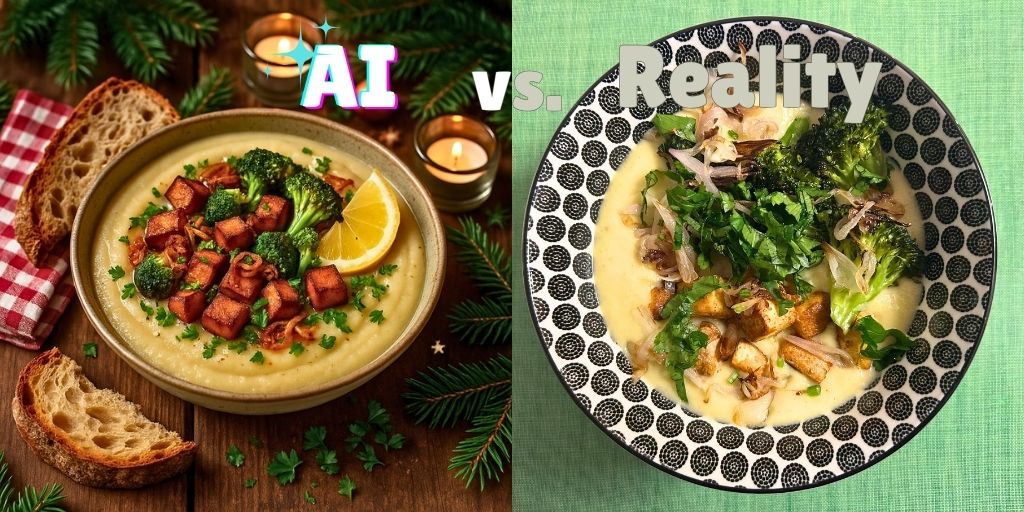
A festive, plant-based comfort bowl that feels right at home on a Scandinavian julbord and a modern Bavarian Christmas menu. Rich, smoky, bright, and surprisingly elegant for a recipe that came out of an AI research rabbit hole. A rare case where “Modern Bavarian” doesn’t just work without meat, it cheerfully proves all the meat-or-nothing crowd wrong.

Taste
Deep, cozy, wintery flavors with a proper restaurant-level “wow” factor. The sweet earthiness of topinambur, the gentle leek, the smoke from the tofu and paprika, and the lemony lift all land exactly where they should. Finally an AI-generated meal that tastes like a restaurant special, not a beta test.

Portion Size
It comfortably feeds 3 people if you serve it with bread, maybe a simple salad, and a dessert. If you skip the sides and just rely on the bowl itself, it’s more realistically a generous meal for 2 (or 2 adults plus someone who “isn’t really hungry” and then eats half your portion).

Combination
Everything on the plate feels like it belongs together: sweet-earthy purée, smoky tofu, lemony broccoli, bright herbs, and crunchy shallots all pulling in the same direction. Nothing screams for adjustment or replacement.

Texture
Soft, creamy base plus properly crispy tofu and shallots, with just-charred broccoli to keep things interesting. It is one of those bowls where every spoonful gives a different mix of crunch and velvet.

Spices
Seasoning is on point right out of the box: gentle smokiness, enough acidity, and no need to rescue anything with extra spice raids from the cupboard. Salt and pepper to taste is really all it takes.

Timing
Fifty minutes is optimistic for mortals with only two hands. Plan on around 70 minutes of focused cooking time; it’s a bit much for a rushed Tuesday, but absolutely fine for a weekend or special-occasion dinner.

Processing
The workflow is solid and the steps make sense; nothing feels like AI chaos for the sake of it. Just keep an eye on the broccoli and start checking at 12–13 minutes—depending on your oven it can quickly go from charred to “Bavarian coal.”

Completeness
Nothing essential is missing. You get comfort, protein, crunch, color, and a built‑in sauce in one bowl—plus bread on the side if you like.

Environment
Plant-based, heavy on seasonal vegetables and modest on processed extras, this one earns a clean conscience badge alongside the empty plates. A great example of comfort food that doesn’t lean on animal products for depth.

Health
The bowl ticks nearly all EAT‑Lancet Planetary Health Diet boxes: fully plant‑based, rich in unsaturated fats from oils and nuts, and powered by fibre‑dense topinambur, leeks, and broccoli. For bonus points, pair it with whole‑grain bread and keep the salt at a sensible level.

Tips for Redemption
- Serve it as one star of a larger julbord with the suggested apple–radish salad and a rich vegan dessert.
- Keep a close eye on the broccoli so it chars, not burns.
- In a hurry? Swap soaked cashews for cashew butter when making the cream—no soaking, extra smooth, and one less thing to remember.