Authors: Cobaia Kitchen, Perplexity Deep Research, Claude Sonnet 4.5
Photos: Cobaia Kitchen, Nano Banana
We’ll be honest: this recipe was born out of pure laziness (the good kind). We were tired of the weekly “what’s for lunch?” panic and needed to stock our freezer with actual edible food that both office workers and post-school teenagers could reheat without burning down the kitchen. So we did what any modern home cook would do — we turned to AI. Specifically, we unleashed Perplexity’s shiny new Deep Research model and gave it a mission: create a plant-based, low-carbon-footprint dinner for 6 that uses ingredients from our pantry, isn’t another curry or stew, and comes from a cuisine we haven’t cooked yet. Oh, and it had to be freezer-friendly, reheatable, and blog-worthy. No pressure, right? The AI dove into our ingredient lists, cross-checked our “never again” recipes file, scanned available cuisines, and emerged with this Croatian gem — a Soparnik, which we’d never heard of but immediately wanted to devour.
Turns out, Soparnik has serious street cred. This rustic flatbread pie hails from the Poljica region of Dalmatia and dates back to the 15th century, when it was baked by farmers under hot ashes after a long day’s work. It’s so culturally significant that it earned protected geographical indication status from the EU in 2016 — meaning authentic Soparnik can only be called that if it’s made in Poljica using traditional methods. Historically filled with Swiss chard (mangold), garlic, onion, and parsley, then brushed with garlic-infused olive oil, it was a humble fasting meal that’s now a beloved regional treasure. We’ve given it a hearty twist with beans and tofu for protein, making it substantial enough to power through afternoon meetings and homework sessions alike. And yes, it freezes beautifully — future-you will thank present-you.
Please read the review before cooking!
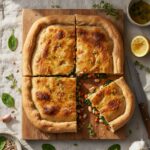
Dalmatian Soparnik
Equipment
- Oven with convection
- Baking sheet
- Baking paper
- Rolling Pin
- Large mixing bowl
- Large pan or braising pan (with lid)
- cutting board
- Japanese kitchen knife (or chef's knife)
- garlic press
- Grater (for carrots)
- kitchen scale
- Measuring cup
- Potato peeler
- Wooden spoon
- Colander
- Basting brush
Ingredients
Dough
- 500 g wheat flour plus extra for dusting
- 250 ml warm water
- 60 ml (4 tbsp) olive oil
- 1 tsp salt
- 1 tsp apple cider vinegar
Filling
- 500 g fresh spinach substitute for Swiss chard
- 1 can (400g) large white beans drained and rinsed (~240g drained weight)
- 200 g smoked tofu crumbled into small pieces
- 2 medium onions (~300g total) finely diced
- 4 cloves garlic (~16g) minced
- 300 g potatoes peeled and cut into 5mm cubes
- 2 medium carrots (~200g) coarsely grated
- 1 large bell pepper (~200g) cut into small dice
- 40 g sunflower seeds
- 2 tbsp (30ml) olive oil
- 2 tbsp (30ml) fresh lemon juice
- 1 tsp smoked paprika
- 1 tsp sweet paprika
- 1 tsp dried oregano
- ½ tsp dried thyme
- ¼ tsp ground nutmeg
- ½ tsp salt
- ½ tsp freshly ground black pepper
Garlic-Herb Oil Finish
- 2 tbsp (30ml) olive oil
- 2 cloves garlic finely minced or pressed
- ½ tsp dried oregano
- Pinch of salt
Instructions
Make the dough (10 minutes + 15 minutes resting)
- Combine 500g wheat flour and 1 tsp salt in a large mixing bowl and make a well in the center.
- Pour in 250ml warm water, 60ml olive oil, and 1 tsp apple cider vinegar.
- Mix with a wooden spoon, then knead by hand on a lightly floured surface for 4–5 minutes until smooth and elastic.
- Divide the dough into two pieces — one slightly larger than the other (about 55/45 split). The larger piece will be the bottom crust.
- Shape each into a ball, cover with a clean kitchen towel, and let rest for at least 15 minutes while you prepare the filling.
Prepare the filling (20 minutes)
- Prep the vegetables: Peel and dice the potatoes into 5mm cubes. Peel and coarsely grate the carrots. Dice the bell pepper into small pieces (~1cm). Finely dice the onions. Mince or press the garlic. Crumble the smoked tofu into small, rough pieces by hand.
- Wilt the spinach: Wash the spinach and place it in a large pan with just the water clinging to the leaves. Cover and cook over medium-high heat for 2–3 minutes until fully wilted. Transfer to a colander and press out as much liquid as possible using the back of a wooden spoon. Roughly chop and set aside.
- Cook the base: Heat 2 tbsp olive oil in the same large pan over medium heat. Add the diced onions and sauté for 3–4 minutes until softened and translucent. Add the minced garlic and cook for 1 minute.
- Add the vegetables: Add the diced potatoes, grated carrots, and diced bell pepper. Stir in the smoked paprika, sweet paprika, oregano, thyme, nutmeg, salt, and pepper. Cook for 5–6 minutes, stirring occasionally, until the potatoes just begin to soften.
- Combine everything: Remove the pan from heat. Fold in the wilted spinach, drained white beans, crumbled smoked tofu, sunflower seeds, and lemon juice. Taste and adjust seasoning. Let the filling cool for a few minutes.
Assemble and bake (5 minutes assembly + 35 minutes baking)
- Preheat the oven to 200°C (convection/fan) or 220°C (top and bottom heat).
- Line a baking sheet with baking paper.
- Roll out the larger dough ball on a lightly floured surface into a large rectangle or oval (~40×30cm), about 3mm thick. Transfer it to the prepared baking sheet.
- Spread the filling evenly over the dough, leaving about a 2cm border on all sides.
- Roll out the smaller dough ball to roughly the same shape as the base.
- Place the top dough over the filling. Fold and press the edges of the bottom dough over the top dough to seal. Use a fork to press the edges firmly together.
- Prick the top of the pie in several places with a fork to allow steam to escape.
- Bake for 30–35 minutes until the crust is golden brown and firm.
Finish with garlic-herb oil
- While the pie bakes, prepare the garlic oil: combine 2 tbsp olive oil with 2 finely minced garlic cloves, ½ tsp dried oregano, and a pinch of salt in a small bowl.
- As soon as the pie comes out of the oven, brush the entire top generously with the garlic-herb oil using a basting brush.
- Let the pie rest for 5 minutes before slicing.
Notes
Serving suggestions:
- Cut into 6 generous rectangular portions using a pizza cutter or sharp knife.
- Serve with a simple side salad of fresh lettuce, cucumber, and tomato dressed with olive oil and white balsamic vinegar.
- A dollop of vegan sour cream on the side pairs beautifully with the smoky, herby filling.
- Pair with a crisp Riesling or a refreshing cucumber-lemon spritzer.
- Freezing & Reheating: Cut into portions, wrap individually, and freeze for up to 3 months. To reheat: place a frozen slice on a paper towel on a microwave-safe plate. Defrost at 30% power for 3–4 minutes, then heat on full power for 1.5–2 minutes. Let rest 1 minute before eating — the filling is hot.
Flour Options
100% Whole Wheat Flour (500g)
- Add 2-3 tablespoons extra water to the dough (total: ~280ml instead of 250ml)
- Let the dough rest for 30 minutes after kneading (instead of the standard 15 minutes)
- Don’t overknead—3-4 minutes is enough
- Result: Nuttier flavor, denser texture, maximum nutritional value
50/50 Mix (250g whole wheat + 250g white flour)
- Add 1-2 tablespoons extra water to the dough (total: ~265ml instead of 250ml)
- Let the dough rest for 20-25 minutes after kneading
- Result: Best of both worlds—easier to roll thin, lighter texture, still healthier than white flour alone
Allergens:
- Cereals containing gluten (wheat)
- Soybeans and products thereof (smoked tofu)
Emission Hotspots:
- Smoked tofu requires processing that doubles the footprint compared to plain tofu.
- Shop to home transportation, if a combustion car is used
Sustainability tips:
- Leftover dough scraps. If you have dough trimmings after shaping the pie, brush them with garlic oil, sprinkle with salt and oregano, and bake them into crispy flatbread chips — a zero-waste snack.
- Label and date your frozen portions. Use the FIFO (First In, First Out) method to make sure older portions get eaten first.
- Choose frozen spinach over fresh. Frozen spinach is flash-frozen at harvest, reducing spoilage waste by up to 30% compared to fresh spinach that wilts quickly. It also works perfectly in this filling since the spinach gets cooked down anyway.
- Skip preheating. Put the assembled pie into the cold oven and add 5 minutes to the baking time. This saves the energy used during the preheat phase.
- Turn off the oven 5 minutes early. The residual heat is more than enough to finish baking the crust — a classic trick that saves energy without affecting the result.
- Walk or bike to the supermarket and farmer’s market to cut transportation emissions
- Guinea pigs 🐹 will love any leftover fresh spinach, carrots, carrot greens and bell pepper
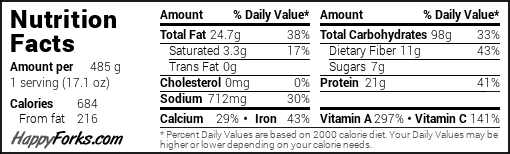
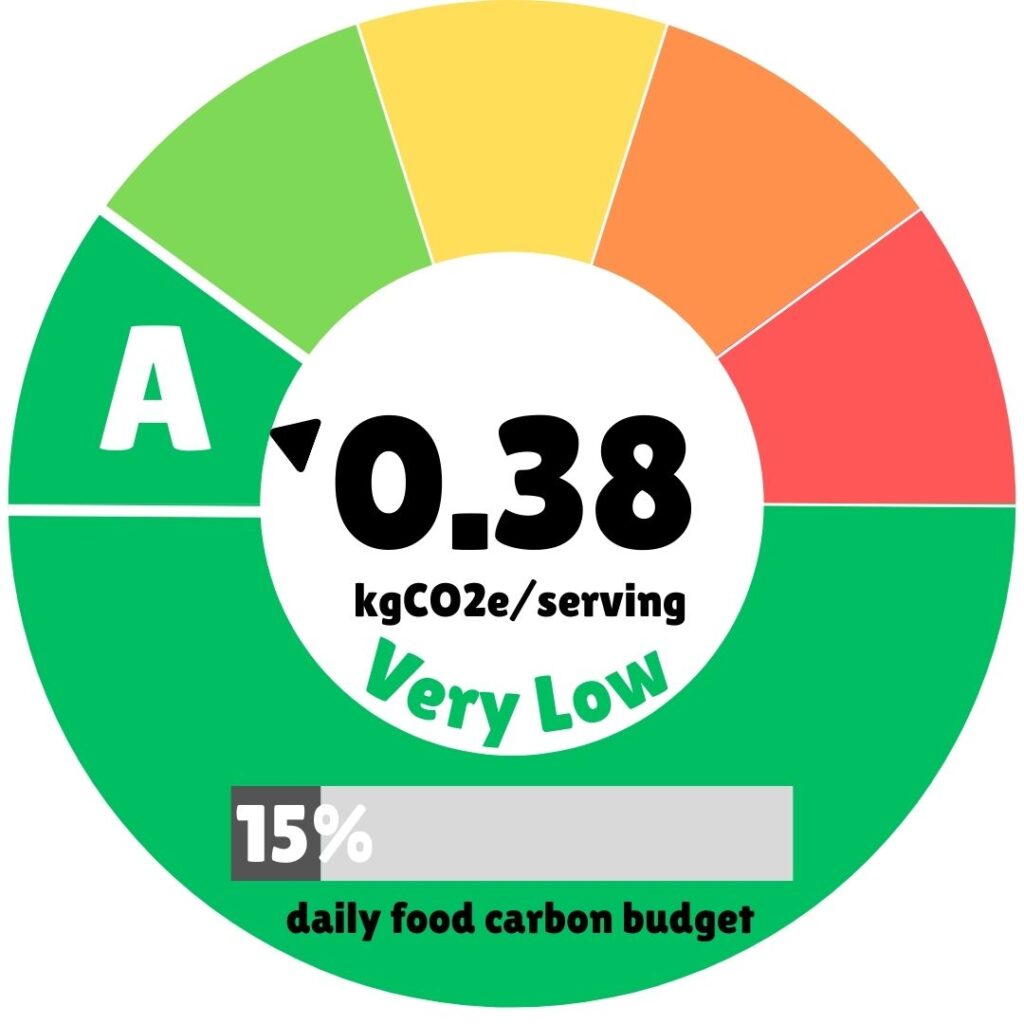
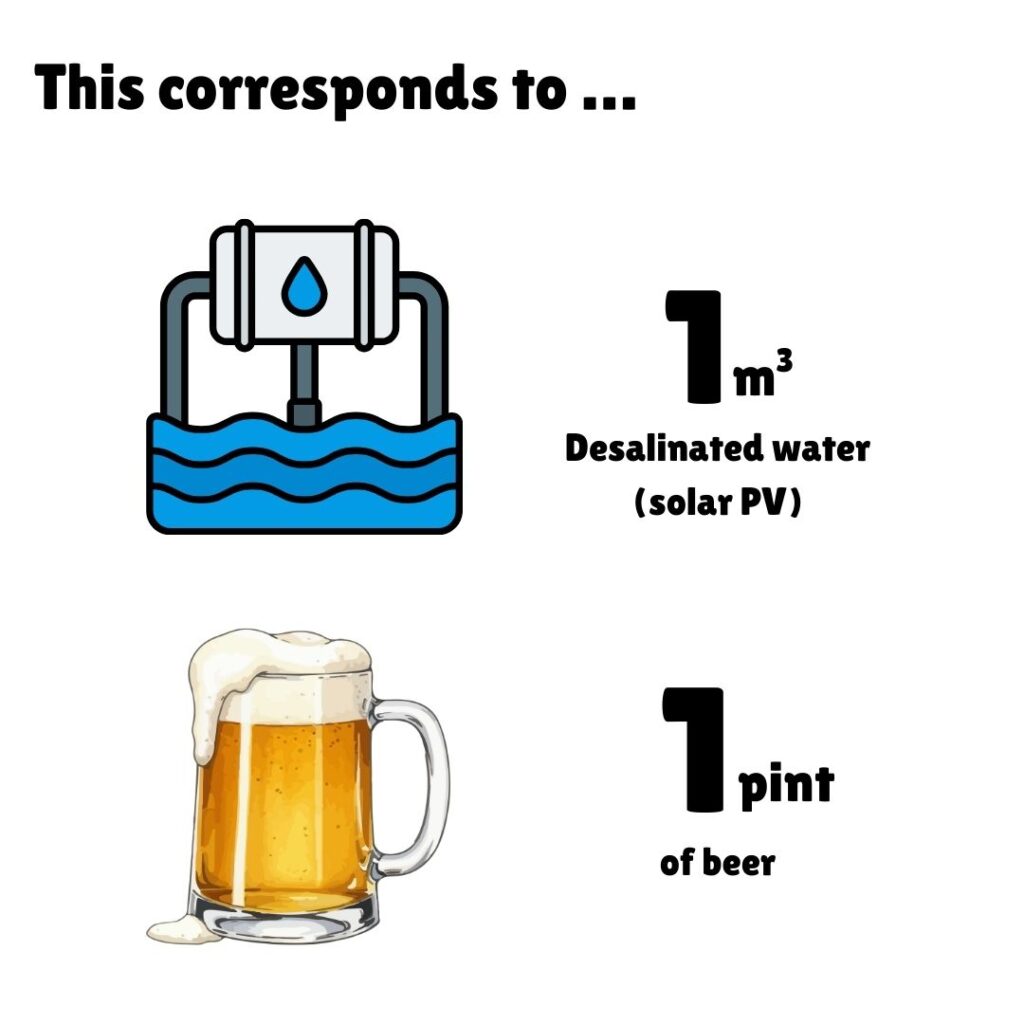
Carbon Footprint
Featured Story
Verification Required
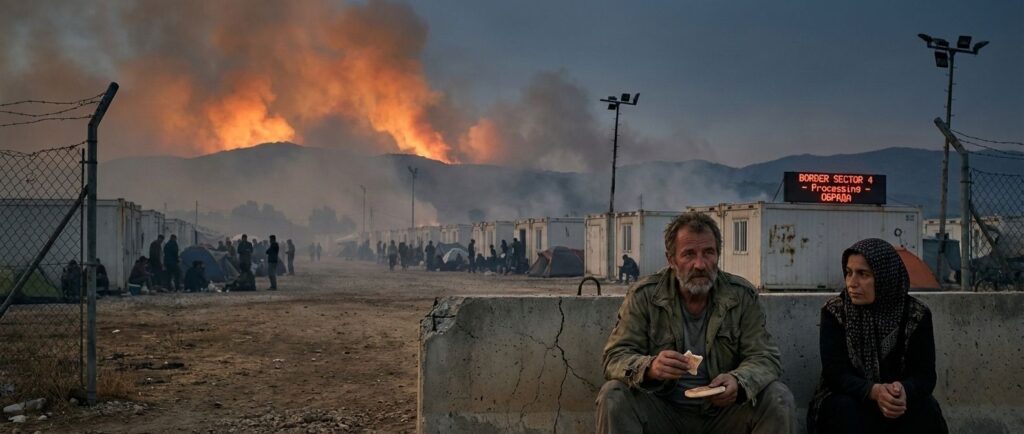
Dr. Emir Hadžić was three kilometers from home when the power went out for the fourth time that week. The AI-managed camp—official designation: EU External Border Processing Facility HR-BiH-03—sat just inside Croatian territory, near the town of Metković, close enough to the Bosnian border that Emir could see the hills where he’d grown up. The camp went silent except for the generator cough and the crackle of distant flames. Emir sat in Sector C, Subsection 11, Refugee Number 4729 in a queue that had not moved in sixteen months. He knew the number by heart. The AI system printed it on his water ration card, his meal voucher, his denied asylum appeal, and his daily weather advisory, which today read: EXTREME FIRE RISK. REMAIN CALM. DO NOT APPROACH PERIMETER FENCE.
The AI had been designed in Brussels by a consortium that won the contract with a PowerPoint slide titled “Efficiency Through Automation.” It spoke forty-seven languages, processed biometric data at 10,000 entries per second, and could determine refugee status based on a proprietary algorithm that weighed seventy-three variables including country of origin, employment history, and something called “Cultural Integration Potential Score.” What it could not do, Emir discovered, was process asylum appeals from people whose profession was listed as “climate scientist.” The system flagged the term automatically. Political Agitator: Verification Required. His file had been in Verification for 487 days. The AI assured him, in flawless Bosnian, that his case was a priority.
When the desalination plant shut down—collateral damage from the grid failure caused by the wildfire that had already consumed half of the Neretva Delta—the camp’s water reserves lasted eleven hours. The AI continued its announcements in rotation: Croatian, Bosnian, Arabic, Farsi, Pashto, Somali. Potable water distribution suspended. Emergency services notified. Estimated response time: 6–8 hours. Please conserve resources. Emir stood in the dust with nineteen thousand other people and watched the smoke roll in from the coastal mountains, where the forest had been burning for three weeks. He thought about the 2031 paper he’d co-authored, Projected Wildfire Frequency in the Western Balkans Under RCP 8.5 Scenarios, which had predicted exactly this. The Croatian government had defunded his institute four months after publication. He still had a copy on a USB stick in his jacket, though there was no longer any device in the camp to read it.
By evening, the wind shifted and the fire turned toward the coast—and the camp. Emir could see the orange glow through the chain-link fence, advancing down the slopes toward Metković. The generators sputtered out one by one. The AI’s voice, powered by a failing backup battery, cycled through its evacuation protocol: Please proceed in an orderly fashion to designated assembly points. Emergency transport is en route. Do not attempt to breach the perimeter. Breach of perimeter is a violation of EU Regulation 2089/43. Violators will be detained. Somewhere behind him, a child was crying. Somewhere ahead, the gates remained locked because the magnetic system required power and the manual override required a Croatian border officer, and the nearest officer was evacuating Metković itself.
Emir sat down on the ground, back against a cement barricade that still radiated heat from the afternoon sun. A woman next to him—Egyptian, he thought, though they’d never spoken—was eating something from a small paper package. It looked like flatbread, oily and dark with herbs. She caught him staring and offered him a piece without a word. He took it. It tasted like nothing, or maybe like smoke. He chewed slowly and watched the fire crest the ridge, a line of light advancing through the dead brush. The AI announced, in a flat tone, that Croatia was no longer accepting asylum applications from persons originating in climatically non-viable zones. Emir closed his eyes. Across the fence, barely visible through the smoke, were the hills of Bosnia where he’d collected his first soil samples twenty-three years ago. He wondered if the USB stick in his pocket would survive the fire, and whether anyone would ever find it, and whether it would matter if they did.
Culinary Reality Check
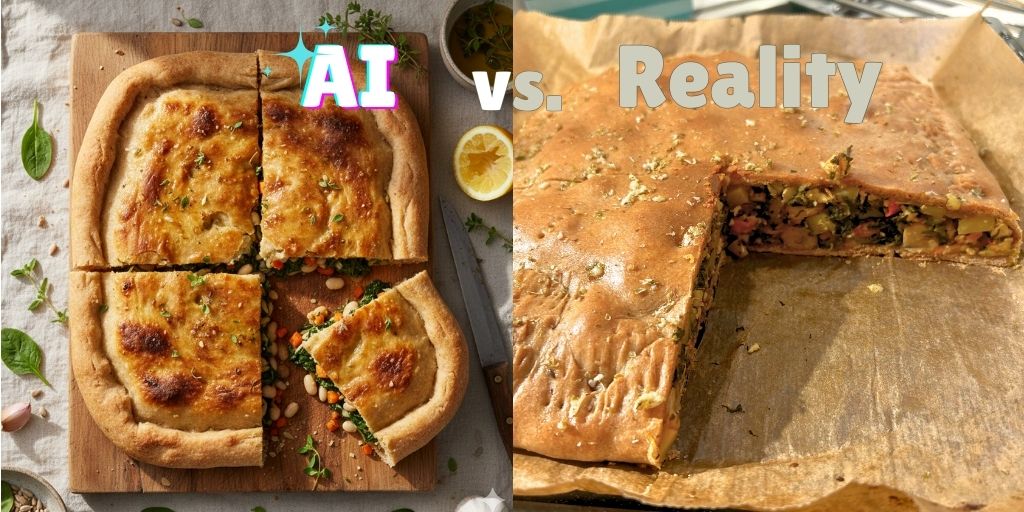
Let’s be clear: this is a massive slab of carbohydrate-encased vegetation. Even using a 50/50 whole wheat blend, it emerged from the oven looking like something that could survive a nuclear winter and still be edible in 2047. Both me and my taste tester had the same immediate, primal reaction: where is the tomato sauce?

Taste
Functional. Nutritious. A bit like eating virtuous cardboard that’s good for you but forgot to bring personality to the party.

Portion Size
We requested 6 portions for our freezer-lunch apocalypse stockpile. The AI delivered approximately 8. Either the algorithm can’t do math, or it assumed we’d need extra rations for the coming collapse.

Combination
This flatbread is basically screaming into the void for moisture. It demands a tomato sauce with the desperation of a climate refugee at a locked border gate. A green salad wouldn’t hurt either, if only to pretend we’re still respectable humans with functioning taste buds.

Texture
Too much dough, not enough mercy. We rolled it as thin as physically possible without tearing the fabric of spacetime, yet it still felt like biting into a well-meaning but overly enthusiastic carbohydrate fortress. More oil might help. Or acceptance.

Spices
The spice levels are what you’d call “politely Croatian.” It could handle—nay, needs—more salt, more garlic, more everything. This is not the time for restraint. The 2040s won’t have restraint. Neither should your seasoning.

Timing
Nearly 2 hours from start to oven-exit. By the time it was done, all energy reserves were depleted. No sides were made. We collapsed. The flatbread won.

Processing
No issues. The dough cooperated. The filling behaved. Everything worked exactly as the AI promised, which is somehow both reassuring and mildly unsettling.

Completeness
Moisture is the missing link. This recipe is 90% brilliant and 10% Sahara Desert.

Environment
A perfect planetary health diet specimen. If the world doesn’t collapse, at least your carbon footprint will be low while you eat dry flatbread in your kitchen.

Health
This recipe is an exemplary planetary health meal, offering a diverse mix of plant-based proteins, unsaturated fats, and an abundance of vegetables that fulfills 40% of the daily vegetable requirement in a single sitting. Two minor considerations: the potato content (50g per serving) exactly hits the EAT-Lancet daily maximum for starchy tubers, so don’t plan on french fries later. As for the crust, we used a 50/50 mix of whole wheat and white flour—perfectly acceptable under the planetary health diet guidelines, though going full whole wheat would push it into gold-star territory. Either way, you’re eating virtuously while carb-loading for the apocalypse.

Tips for Redemption
- Make a simple tomato sauce. Not negotiable. This is survival.
- Use more olive oil. Everywhere. In the dough, on the dough, around the dough.
- Be aggressive with spices. Salt like you mean it. Garlic like the AI apocalypse is coming.
- Add a green salad. Something fresh to remind you that moisture still exists in the world.