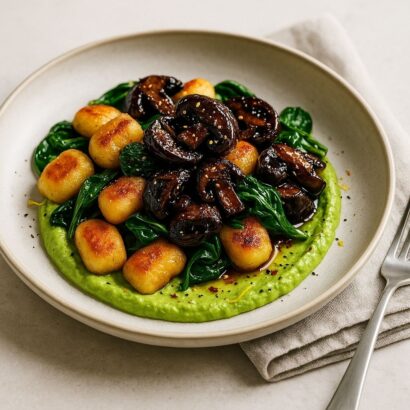
Authors: Cobaia Kitchen, Kimi K2 Thinking, Gemini 3 Pro
Photos: Cobaia Kitchen, Seedream 4.5, Nano Banana
Recent headlines have been unsettling: a military raid in Venezuela, followed by repeated public statements that Greenland—an autonomous territory within the Kingdom of Denmark—will be “secured” by force if necessary. What once sounded like political posturing now feels more like a countdown. Disturbed by this geopolitical tension and craving a bit of culinary escapism, we turned to the Kimi K2 Thinking model with an unusual request: create a modern, plant-based version of suaasat, Greenland’s national dish, to pair with a short story we were writing about life in a hypothetical, annexed Greenland of 2049. Traditionally, suaasat is a hearty, survivalist soup made from seal meat, barley, onions, and potatoes—designed to sustain Inuit hunters through brutal Arctic winters and long, dark months of isolation.
We asked the AI to keep the soul of the dish while swapping the seal for ingredients that might actually be available in a resource-scarce future (or your local supermarket). The model came up with this rich barley and root vegetable stew, using seaweed to evoke the traditional oceanic flavor profile without the hunt. It is the perfect warming bowl to eat while reading our fictional—but perhaps chillingly realistic—short story below about life in the Narsaq of 2049.
Please read the review before cooking!
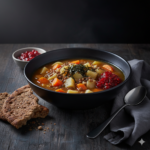
Arctic Suaasat Stew with Seaweed
Equipment
- Cutting board and sharp knife
- Large pot with lid
- Medium frying pan (preferably non‑stick)
- mixing bowl
- Wooden spoon or spatula
- Measuring cup and spoons
- Ladle
Ingredients
Arctic suaasat-style stew
- 1 tbsp rapeseed oil plus 1 tbsp reserved for bread
- 1 medium onion about 150 g, finely diced
- 1 small leek about 80 g, halved lengthwise, then sliced into half-moons
- 2 garlic cloves finely chopped
- 2 medium carrots about 160 g, peeled, cut into 1 cm cubes
- 1 small piece celeriac about 100 g, peeled, cut into 1 cm cubes
- 300 g waxy potatoes peeled, cut into 1.5 cm cubes
- 75 g pearl barley rinsed under cold water
- 90 g dry green or brown lentils rinsed (or “mountain lentils” from your stock)
- 1 L water + 2 tsp vegetable broth powder or equivalent ready-made broth
- 1 bay leaf
- ½ tsp dried thyme
- 1 tbsp seaweed flakes or 1 nori sheet finely crumbled, for a “sea” aroma
- 50 ml oat or soy cooking cream optional, for extra richness
- Salt and freshly ground black pepper to taste
Berry–apple Arctic relish
- 150 g frozen raspberries
- 1 medium apple about 150 g, peeled, cored, cut into small cubes
- 1 tbsp lemon juice
- 1 tbsp sugar or to taste
Quick rye skillet bread
- 90 g rye flour
- 45 g wheat flour regular or bread flour
- 1 tsp baking powder
- ¼ tsp fine salt
- 1 tbsp rapeseed oil from total oil amount above
- About 80–90 ml lukewarm water as needed to form a soft dough
Instructions
Start the stew base
- Heat 1 tbsp rapeseed oil in a large pot over medium heat.
- Add the diced onion and sliced leek; sauté 5–6 minutes until soft and lightly golden, stirring occasionally.
- Add chopped garlic and cook 1 minute until fragrant, without browning.
Build the Arctic vegetable mix
- Add carrot and celeriac cubes; stir and cook for 3 minutes.
- Add the potato cubes, rinsed barley and rinsed lentils, and stir to coat everything in the aromatic oil.
Simmer with seaweed
- Pour in 1 L water and stir in the vegetable broth powder until dissolved.
- Add bay leaf, dried thyme and seaweed flakes or crumbled nori.
- Bring to a boil, then reduce to a gentle simmer, cover and cook 30–35 minutes, stirring occasionally, until barley and lentils are tender and the soup is thick and hearty.
Finish the stew
- Remove the lid for the last 5 minutes if you want it thicker; add a splash of water if it gets too thick.
- Stir in the oat/soy cream (if using), then season generously with salt and black pepper.
- Remove the bay leaf, taste and adjust seasoning. Keep warm over very low heat.
Make the berry–apple relish
- While the stew simmers, place raspberries and apple cubes in a small saucepan.
- Add lemon juice and sugar, stir and bring to a gentle simmer over medium‑low heat.
- Cook 5–7 minutes, stirring occasionally, until the berries break down and the apple is just tender but still holds some shape.
- Taste and adjust sweetness or acidity; set aside to cool slightly.
Prepare the rye skillet bread
- In a mixing bowl, combine rye flour, wheat flour, baking powder and salt.
- Add 1 tbsp rapeseed oil and about 80 ml water; mix with a spoon, then knead briefly with your hands until you have a soft, non‑sticky dough, adding a teaspoon more water or flour if needed.
- Divide the dough into 3 equal balls (one per portion).
- On a lightly floured surface, roll or press each ball into a thin round or oval, about 3–4 mm thick.
- Heat a dry frying pan over medium heat. Cook each flatbread 2–3 minutes per side until puffed in spots and lightly browned, pressing down with a spatula for even contact.
- Wrap the finished breads in a clean kitchen towel to keep them warm and soft.
Notes
Serving suggestions:
- Ladle the hot Arctic suaasat-style stew into deep bowls, making sure each portion gets a good mix of barley, lentils and root vegetables.
- Spoon a generous dollop of berry–apple relish on top or on the side of each bowl; the sweet–tart berries echo Greenlandic berry garnishes served with savoury dishes.
- Serve immediately with warm rye skillet bread for dipping; the combination of barley, rye, seaweed and berries gives a distinctly Nordic/Greenlandic flavour profile while remaining fully plant-based and low in climate impact compared to meat‑based versions of suaasat.
Allergens:
- Cereals containing Gluten (present in Pearl Barley, Rye Flour, Wheat Flour, and Oat Cream)
- Celery (present in Celeriac and likely in the Vegetable Broth)
- Soybeans (only if using Soy Cream instead of Oat Cream)
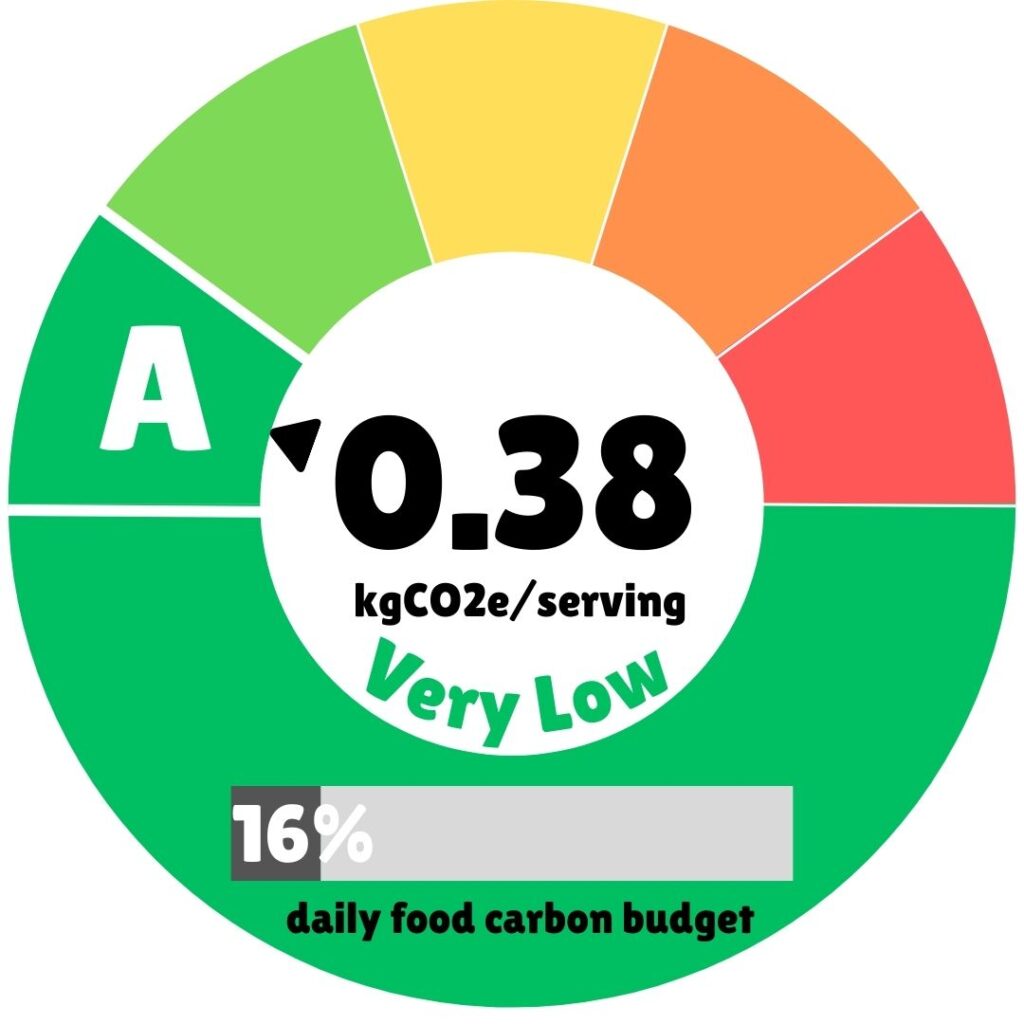
Emission Hotspots:
- Shop to home transportation, if a combustion car is used
Sustainability tips:
- Use a rice cooker with soup function for the soup to cut energy use compared to cooking everything on the stovetop.
- Energy-Efficient Simmering: Soaking your pearl barley and lentils for a few hours or overnight before cooking can significantly reduce the simmering time (and thus your energy usage) by up to 50%.
- Choose seasonal, locally grown vegetables to reduce transport and storage emissions while supporting regional farmers.
- Store leftover purée and toppings in airtight containers and reheat for lunch the next day—using a microwave for quick, low‑energy reheating.
- Compost your vegetable trimmings, turning them into nutrient-rich soil instead of landfill waste.
- Walk or bike to the supermarket and farmer’s market to cut transportation emissions
- Make your guinea pigs 🐹 happy by giving them all the remaining carrots and carrot greens.
Carbon Footprint
Featured Story
The Last Radio

Narsaq, Southern Kalaallit Nunaat (Greenland), 2049
The rare earth mine at Tanbreez runs on a heartbeat of three shifts a day, grinding the Kringlerne plateau down to feed the factories in Cleveland and Austin. They take the neodymium for quantum computers and the lithium for batteries that power a world Malik will never see. He moves through the ventilation shaft by memory, his headlamp switched off, counting the rivets with his fingertips—eighty-seven, eighty-eight—until he reaches the old junction where the air still smells like the fjord instead of chemical dust. Behind a loose panel, exactly where old Aqqalu said it would be, he finds it: the shortwave radio. It is a relic from before the Annexation, untraceable and illegal enough to earn him twenty years in the labor compounds the Americans built where the sheep farms used to be.
Malik remembers the beginning clearly. He was just a boy in 2026 when the American warships arrived in Nuuk harbor. It was a political maneuver then, a “strategic acquisition” signed in boardrooms while Europe looked away. The Danish Navy turned back without firing a shot, and the stars and stripes went up over the parliament in Nuuk. Life continued, harder but recognizable, for nearly a decade. Then came the shift.
It wasn’t a single day, like in the movies. They called it “The Great Slowing” of the 2030s. The AMOC—the ocean’s heartbeat—began to stutter. The heat that used to flow north faltered, and the weather went mad. Europe didn’t freeze overnight, but it began to starve as droughts and erratic frosts broke its agriculture. Consumed by bread riots and failing economies, the EU turned inward, losing all interest in defending a distant, American-owned island. Greenland was left entirely to the mercy of the corporations. Now, the winters are longer, the storms more violent, and the southern fjords are choked with unpredictable ice that defies the old calendars.
The radio crackles to life—Copenhagen, the frequency Aqqalu died protecting. “Qaqortoq to Storm Petrel, come in.” Malik keeps his voice low, a whisper against the machinery’s roar three levels below. “Storm Petrel reading. Package is ready.” The “package” is forty-seven Kalaallit children, the youngest six, the oldest fourteen. They are hidden in the belly of a fishing trawler that will sail tonight. They will run the gauntlet to Iceland, where the Nordic Council maintains the last embassy, a final toehold of the Europe that abandoned them but never quite forgot. Malik’s own daughter, Pipaluk, is among them.
“Storm Petrel, be advised,” the voice cuts through the static. “American destroyers repositioning along the coast. The storm front is stalling. You have a two-hour window before the sensors clear.” Malik’s chest tightens. The storms, once their enemy, are now their only cover. In two hours, he has to disable the port surveillance grid and create enough chaos for a single trawler to slip through the sensor net that turned their waters into an American lake. The backup plan sits in his pack: twenty kilos of fertilizer and fuel oil. Enough to take out the main power substation. “Understood, Copenhagen,” he says. “Storm Petrel will be in position.”
At 17:30, Malik surfaces in the worker’s bathroom, scrubbing the shaft dust from his face. In the cafeteria, he orders the evening meal. There are no seals anymore to hunt; the migration routes were disrupted years ago by the warming southern oceans and the cooling north. The company serves reconstituted protein from American algae farms and synthetic grains. He sits alone and eats mechanically, watching the clock, thinking of Pipaluk’s face. She looks exactly like her mother. She still remembers the words to the old songs, even though they were banned from the schools years ago. At 17:55, he walks to the substation. The guard knows him, waves him through—just Malik the electrician, doing another evening repair in a grid that fails constantly under the stress of the worsening climate.
At 18:00 precisely, the charge blows. The lights die. The sirens scream, struggling against the howling wind. And in the darkness and confusion, somewhere in the harbor, a small boat with forty-seven children slips its moorings. The captain navigates not by GPS, but by the old ways—reading the chaotic swells and the taste of the freezing wind.
Malik never reaches the extraction point. The security forces find him seventeen minutes later, kneeling on the frozen ground. He doesn’t fight. Fighting was never the point. As they drag him toward the transport vehicle, he tilts his head back and sees it—one star breaking through the heavy cloud cover, bright and cold. He thinks of Pipaluk, sailing toward it. He thinks: That’s enough. That’s enough for any father. And when they ask him why, he says nothing at all.
Culinary Reality Check

Rating: Solidly Survival-Ready (and surprisingly tasty)
When we first saw “pearl barley” on the manifest, we had flashbacks to a disastrous German barley soup experiment from the archives. We braced ourselves for bland rations, but the result was unexpectedly comforting.

Taste
Better than “just sustenance.” We were initially skeptical about the raspberry-apple relish—our instincts screamed for Nordic lingonberries, but supply lines being what they are (we couldn’t find frozen ones locally), we trusted the recipe. We were wrong to doubt. The tart, bright acidity of the fruit lifts the entire bowl from “grey stormy day” to “interesting culinary contrast.” The seaweed, however, was a ghost. We used standard Nori sheets, and the flavor completely vanished into the broth. Perhaps a hardier kelp is needed to truly taste the ocean.

Portion Size
Accurate logistics. The recipe claimed to feed three, and it successfully silenced three hungry critics. No rationing required.

Combination
Surprisingly harmonious. The earthy root vegetables and the sharp, sweet fruit create a balance that feels both ancient and modern.

Texture
Reliable. The barley provided a satisfying chew, the vegetables held their shape, and the flatbread offered the necessary crunch. Nothing to complain about.

Spices
A mixed bag. As noted, the “sea” element was lost at sea—the Nori dissolved into the background. However, the sour punch from the relish harmonized perfectly with the savory depths of the stew, which otherwise largely took on the character of the vegetable broth.

Timing
Slight delay. We ran about 5 minutes over the estimated extraction time. Plan accordingly if you’re on a tight schedule.

Processing
Clear instructions. Every step was logical and easy to execute, even without professional equipment.

Completeness
Fully stocked. No missing components or vague directives.

Environment
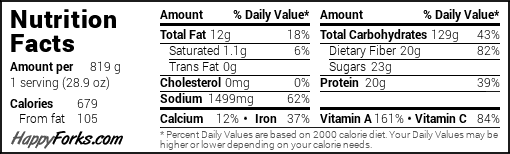
Rating: A. A meal that treads lightly on a fragile planet. Low carbon, high sustainability.

Health
A nutritional stronghold. This recipe is an exceptionally healthy, plant-forward meal that excels in providing diverse vegetables, quality whole grains, and sustainable plant protein, aligning closely with the EAT-Lancet Commission’s core principles. Its only significant deviation is the high potato content, which technically exceeds the strict planetary boundary for starchy tubers—but given the high fiber and nutrient density of the rest of the dish, we consider this a forgivable indulgence for a cold climate.

Tips for Redemption
- Berry Swap: If the raspberry intel feels wrong to you, scout for lingonberries. They are the traditional choice for a reason.
- Ocean Booster: If you actually want a stronger marine flavor (we’re still debating if we do), try a more potent seaweed variety or double the Nori ration.